How to Choose the Best Online Puja Service Website: A Trust Checklist
A practical checklist for comparing online puja websites, understanding ritual scope and pricing, verifying the provider and booking through a safer process.

Choosing a reliable online puja service should begin with clarity, not promotional claims. Before paying, understand who will perform the ceremony, what is included, how Sankalp is taken, whether you can participate remotely, where the ceremony will take place, and what you receive after completion.
Families today may live in different cities or countries while still wanting to follow traditional practices. A digital platform can make that process easier by helping a devotee select the appropriate ceremony, confirm the priest and schedule, submit the required details, and complete the booking securely.
This guide explains how to compare online puja services in India, understand different service formats, evaluate priests, compare prices, identify trust signals, and choose a ceremony that matches your religious requirement.
Start with the right ceremony
Start with the religious occasion rather than the package price.
Different pooja may involve different prayers, preparation, duration, priests, materials, dates, and participation methods. A larger package is not automatically more suitable for every family.
Before making a decision, ask:
- What ceremony do I actually need?
- Is it connected with a festival, family event, prayer, or traditional observance?
- Does the priest need to visit my home?
- Can the ceremony be performed remotely?
- Is a particular date important?
- Do I want to participate live?
- Is the ceremony private or shared?
A clear answer to these questions makes the selection process much easier.
Understand online puja formats
The phrase “online” can describe several service formats. Understanding the difference prevents confusion later.
The priest performs the agreed ritual at the confirmed location using the family's Sankalp information.
The family may participate during selected stages or may receive confirmation after completion, depending on the service.
This format can be useful when the devotee cannot travel to the performance location.
Some families prefer to participate directly from their own prayer space.
In this format, the priest provides remote instructions while the family performs selected steps at home.
A guided pooja experience may require the family to prepare certain items beforehand.
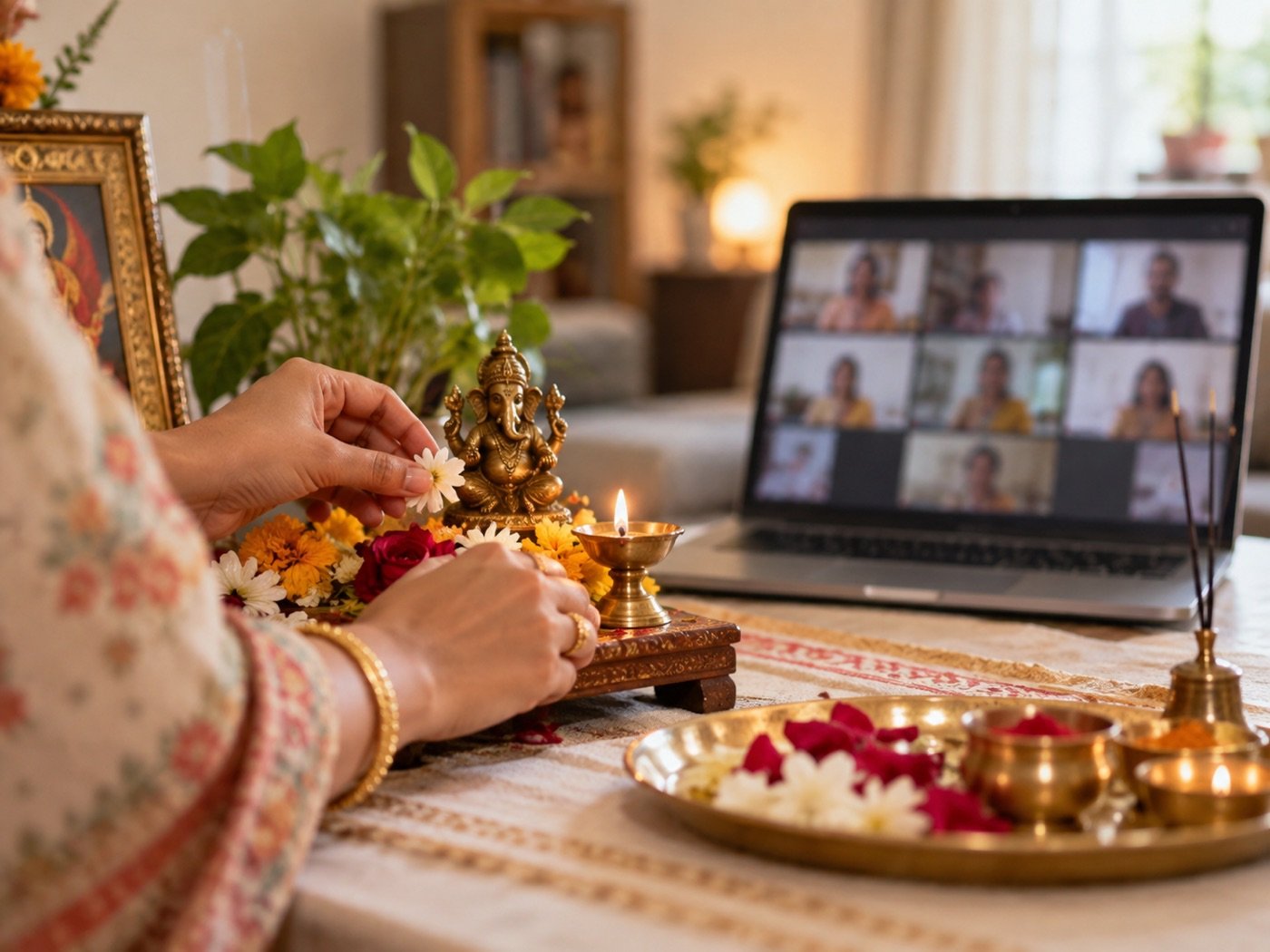
Selected services may allow family members to connect during the ceremony through video.
Before confirming, check whether the session includes:
- two-way interaction;
- Sankalp participation;
- family joining;
- live streaming;
- recording;
- selected prayer instructions.
Some location-based services may also provide live darshan when that feature is specifically included.
A website may also let you arrange a priest digitally while the ceremony itself takes place at your home.
This is different from a ceremony performed remotely.
For property-related or family events, confirm whether physical presence is necessary before you book online.
A temple puja may be appropriate when worship is specifically connected with a sacred location or particular deity.
When comparing a service connected with a temple, confirm:
- the exact place of performance;
- who conducts the ceremony;
- what Sankalp details are required;
- whether the service is individual or shared;
- whether remote participation is provided;
- what proof or follow-up is included.
A genuine sacred-location service should identify the place clearly rather than using vague references.
If a ceremony is presented as being performed at a Hindu temple, the website should provide enough information for users to understand where and how the service is carried out.
Know who performs the worship
The person conducting the worship is one of the most important trust factors.
A professional platform should name the Pandit or explain the assignment process.
Useful information can include:
- traditional education;
- relevant experience;
- language;
- location;
- ceremonies regularly performed;
- contact or support details.
Terms such as verified Pandits, experienced Pandits, experienced priests, or verified experienced professionals should be supported by meaningful information.
The goal is not simply to display a badge. Families should understand who is responsible for performing the service.
Some regional traditions may use the word Purohits for priests performing religious ceremonies.
Sankalp and family details
Sankalp connects the ceremony with the person or family for whom it is being performed.
A personalized puja may require information such as:
- name;
- family member details;
- Gotra, when known;
- location;
- purpose of worship;
- preferred date.
Always check spellings before submitting the information.
Do not guess.
Tell Pandit Ji that the Gotra is not known and follow the traditional guidance provided for the selected ceremony.
A responsible provider should help the family proceed without creating unnecessary fear or confusion.
Individual and shared ceremonies
A major comparison point is whether the ceremony is dedicated to one family or performed with several participating families.
A dedicated arrangement generally gives one household its own service slot.
This format may be suitable when:
- a specific family requirement exists;
- dedicated Sankalp is preferred;
- private participation matters;
- the family wants a specific schedule.
A shared arrangement may include several participants within the same larger event.
Each family's details may be included according to the defined process.
Group formats are common around festivals, major observances, or high-demand dates.
Neither option is automatically better. The right format depends on the family's requirement.
Understand Homa, Homam and Yagna
Different fire and prayer ceremonies have different structures.
A Vedic hindu puja services may include recitation, offerings, worship, Sankalp, or a sacred-fire component depending on the ceremony.
A Homa generally includes offerings made into the sacred fire along with prescribed prayer recitation.
The word Homam is also commonly used in several regional traditions.
Before selecting one, confirm:
- purpose;
- duration;
- materials;
- number of priests;
- participation;
- whether a dedicated Sankalp is included.
Yagnas may involve a larger or extended ceremonial process.
Some may require additional priests or longer preparation.
The service page should clearly explain the scope instead of relying only on a broad spiritual description.
Well-presented Vedic Online pujas should describe the ceremony accurately and explain what the family needs to prepare.
This allows users to understand the religious service without turning the page into exaggerated marketing.
Choose a ceremony for the occasion
Different families approach a priest for different reasons. The ceremony should match the occasion and family tradition.
Satyanarayan worship is traditionally connected with Lord Vishnu.
Families may arrange it for an auspicious family occasion, homams, prayer, thanksgiving, or according to household custom.
A service page should clarify whether Katha, Sankalp, offerings, and family participation are included.
Rudrabhishek is associated with Shiva worship and traditionally includes Abhishek along with prescribed prayers and offerings.
The scope can vary, so compare what is included rather than assuming all packages are identical.
Ganesh worship is traditionally performed before many important beginnings and family occasions.
During Ganesh Chaturthi, demand may increase, so families should confirm the date and availability in advance.
Krishna-related ceremonies can vary by festival, family tradition, Katha, or Vrat.
Check the exact ceremony before selecting a package.
Dates, tithi and Muhurat
Certain ceremonies can be arranged on a convenient date, while others may be connected with a religious calendar.
Relevant factors can include:
- festival date;
- tithi;
- location;
- Muhurat;
- lunar phase;
- family tradition.
Some observances may take place on Purnima, also known as a full moon day.
Others may be connected with Amavasya, Shukla Paksha, or another traditional period.
The appropriate timing should be confirmed for ceremonies where the religious calendar is important.
A responsible provider should not claim that one universal date is suitable for every family or every ceremony.
Ancestor-related observances
Ancestor-related worship can use different terminology depending on region and family custom.
Terms such as Pitra, Pitru, Shraddha, and Pitru Paksha may appear in service descriptions.
Some observances may also relate to the traditional month of Bhadrapada.
Before selecting an ancestor-related ceremony, confirm:
- the exact procedure;
- location;
- family details required;
- priest;
- date;
- whether Daan forms part of the arrangement.
If Daan is included, the provider should explain what is offered and how it is handled.
Considering Dosh Nivaran
Some families explore religious ceremonies after receiving advice connected with astrology.
An astrologer may refer to planetary positions, a Kundli, or traditional doshas, but the service provider should still explain the actual ceremony being offered.
If you are considering Dosh Nivaran, check:
- the purpose described in the tradition;
- associated worship;
- ceremony format;
- required information;
- whether a fire ceremony is included;
- expected duration.
Religious or Jyotish-based practices should not be presented as guaranteed solutions for medical, legal, financial, career, or relationship problems.
How to book online puja
A good puja booking service should make the customer journey clear from the beginning.
A practical process can look like this:
- Select the ceremony.
- Read the complete service information.
- Share the required Sankalp details.
- Confirm the date and location.
- Understand the participation format.
- Review the materials and inclusions.
- Complete the payment.
- Receive instructions.
- Participate where applicable.
- Receive the promised follow-up items.
A seamless process does not mean removing important details. It means presenting them clearly.
For families who already know which ceremony they need, online puja booking can reduce unnecessary coordination and make the process easier to manage.
Compare complete prices and inclusions
The lowest listed price is not always the most useful comparison.
One provider may quote a shared ceremony, while another price covers a dedicated slot.
Differences can include:
- duration;
- priest count;
- materials;
- sacred-fire arrangements;
- private or group format;
- video participation;
- delivery.
Before payment, compare the actual scope.
Clear inclusions make it easier to compare one provider with another.
Different forms of worship may involve different recitation requirements.
A mantra may be used as part of prayer, Sankalp, Abhishek, fire offerings, or another religious process.
The important point for customers is not to count every chant themselves.
Instead, the service description should explain enough about the ceremony for families to understand what they are purchasing.
Proof, Prasad and delivery
Some providers offer physical or digital follow-up items after completion.
These can include:
- photographs;
- recording;
- ceremony confirmation;
- Prasad;
- shipping information.
Do not assume every service includes all these items.
If something is important to you, confirm it before payment.
Delivery details are especially important when the family lives outside the performance location.
Some websites use the word Sevas for prayer offerings, sacred-location worship, Archana, Abhishek, or other devotional activities.
The exact meaning should be explained on the selected page.
Similarly, an online spiritual platform may offer several types of services, but families should identify the specific ceremony rather than purchasing a broad package without understanding it.
A responsible spiritual service should help people understand what is being arranged.
Respectful claims and real trust signals
Religious ceremonies may carry deep personal meaning for families seeking prayer, divine blessings, or divine grace.
A service website can respectfully describe these beliefs.
However, faith-based language should not be converted into guaranteed commercial promises.
Be cautious of websites promising guaranteed:
- wealth;
- marriage;
- medical improvement;
- legal victory;
- business success.
Respect for belief and transparency can exist together.
The phrase authentic Vedic rituals performed should be supported by substance.
Useful indicators include:
- an identifiable practitioner;
- a clear ceremony description;
- accurate religious terminology;
- defined service format;
- published inclusions;
- real contact information;
- transparent policies;
- responsible claims.
The presence of traditional words alone is not proof of quality.
Users should look at the complete service process.
Privacy and safe payment
Religious services may require names and family information for Sankalp.
That does not mean the provider needs access to confidential banking credentials.
Never share:
- OTP;
- UPI PIN;
- card PIN;
- internet-banking password;
- authentication code.
Use the official checkout or the published payment channel.
A trusted online provider should make payment, privacy, and contact details easy to find.
Booking from outside India
Digital access can help families across India and overseas coordinate religious ceremonies even when relatives live in different locations.
Before confirming an overseas arrangement, check:
- Indian ceremony time;
- your local time;
- joining platform;
- family participation;
- payment method;
- delivery availability.
The process can be especially useful when relatives want to remain connected with traditional Hindu rituals observances while living abroad.
Warning signs before booking
Be cautious when you find:
- anonymous priests;
- unclear service descriptions;
- hidden costs;
- guaranteed life outcomes;
- excessive fear-based language;
- no privacy information;
- no cancellation terms;
- unclear location;
- fake-looking testimonials;
- stock images presented as ceremony proof.
A provider should make the decision easier, not pressure a customer into immediate payment.
Final checklist before payment

Use this checklist before paying.
- Is the priest or assignment method explained?
- Is the ceremony clearly described?
- Is the location known?
- Are the required details explained?
- Is the format individual or shared?
- Is remote participation included?
- Is the complete amount clear?
- Are materials included?
- Are any additional charges explained?
- Are photos or recordings included?
- Is Prasad included?
- Are delivery conditions stated?
- Is the cancellation policy visible?
- Are rescheduling rules available?
- Is privacy explained?
- Is there a working support channel?
The quality of a religious service should not be judged only by how many ceremonies a website lists.
Clear information helps families understand:
- what they are selecting;
- who is responsible;
- how the service works;
- what is included;
- what happens after payment.
That transparency creates a stronger basis for trust than exaggerated superlatives.
About this platform
The same standards should apply to the website publishing this guide.
Pandit Neelesh Shastri's platform identifies the practitioner, provides individual service pages, offers Sankalp-based arrangements, explains remote participation, and publishes support and policy information.
Families should still review the individual service page before payment because different ceremonies can have different duration, requirements, participation formats, and inclusions.
Make an informed decision
A good provider should help you understand the ceremony before asking for payment.
Know who will perform it.
Confirm the Sankalp.
Understand whether the service is individual or shared.
Check the location and schedule.
Review the complete price.
Read the policies.
And verify every important inclusion before completing the booking.
When these details are clear, families can make a more informed decision and select from the available pujas according to their own religious requirement.
Frequently Asked Questions
How do I choose a reliable online puja service?
Check the priest, ceremony description, Sankalp process, location, participation format, complete price, customer support, and policies before paying.
Can I participate in an online puja remotely?
Selected services may support remote participation. Confirm whether the session is live, interactive, shared, or recorded.
What if I do not know my Gotra?
Tell the priest the information is unknown rather than guessing. Follow the guidance given for the selected ceremony.
Is every online puja dedicated to one family?
No. Some are dedicated to one family, while others may be conducted in a shared format. Check before confirming.
Are materials and follow-up items included in every service?
No. Inclusions vary according to the ceremony and provider. Read the service page carefully.
Can a family outside India book an online puja?
Yes, depending on the provider and selected service. Confirm time-zone differences, participation options, payment, and delivery conditions.
Does an online puja guarantee a material result?
No. Religious ceremonies should be understood within their devotional and cultural context, not as guaranteed financial, medical, legal, or relationship outcomes.