How Online Puja Services Evolved in India
People searching for “India's first online puja services website” are often trying to understand whether a digital puja can remain authentic, who performs it and how an ancient tradition can be experienced through modern technology. India has no single official registry recording the first priest, family or website to offer puja through a phone call, video connection or online booking. Online puja developed gradually as practising priests adopted the tools available to serve families living farther away.
Did online puja begin with a website?
No single website created the idea of helping a devotee worship from a distance. Long before modern booking platforms, Indian families stayed connected with their family Pandit by letters and telephone. Names and Sankalp details could be shared before a ceremony, while the priest performed the prescribed ritual at an agreed place. Video calls, digital payments and websites later made communication, scheduling and participation easier.
This distinction matters. Technology can coordinate a ritual, but it does not replace the priest, mantra, Sankalp, Samagri, Agni or the applicable Vidhi. The spiritual practice comes from the tradition; the website is a modern bridge between the priest and the family.
Why is there no government certificate for “India's first”?
Sanatan Dharma and Vedic ritual practice are much older than the internet and are not owned by one company, institution or technology platform. India does not maintain a universal register of every remote puja performed by every priestly family. A claim about the first website is therefore different from the authenticity of the ritual itself.
Authenticity should be assessed through the real person conducting the ceremony, the continuity of practice, the explanation of the Vidhi, the way Sankalp is taken, transparent service information and visible evidence of present-day work. A decorative online badge cannot replace these practical trust signals.
A living family tradition, adapted for today's devotees
Pandit Neelesh Shastri comes from a traditional Brahmin priestly family in which Vedic worship and Yagya have been practised across generations. According to the family history shared for this website, his forefathers also served families through religious ceremonies. This knowledge was carried through observation, disciplined study, guidance from elders and participation in real rituals—not merely through modern paperwork.
Pandit Neelesh Shastri has continued this work by conducting Puja and Yagya for families at their homes over many years. Today, online communication allows the same human guidance to reach devotees who live in another Indian city or outside India. The medium has changed; the responsibility to follow the agreed ritual process remains.
What makes an online puja authentic?
- A clearly identified priest: the devotee should know who is responsible for the ceremony.
- A defined ritual: the service should explain whether it includes Puja, Path, Jaap, Havan or a combined Anushthan.
- Personal Sankalp: required names, worship location, purpose and Gotra if known should be confirmed carefully.
- Appropriate Vidhi: the procedure should follow the selected ritual and family tradition rather than a generic script used for every booking.
- Transparent participation: the family should know whether it will join live, receive guidance at home or have the ritual performed on its behalf.
- Clear inclusions: Samagri, duration, number of priests, follow-up and any delivery must be confirmed before payment.
- No guaranteed outcomes: religious significance can be explained honestly without promising medical, financial, legal or relationship results.
How do real puja videos build trust?
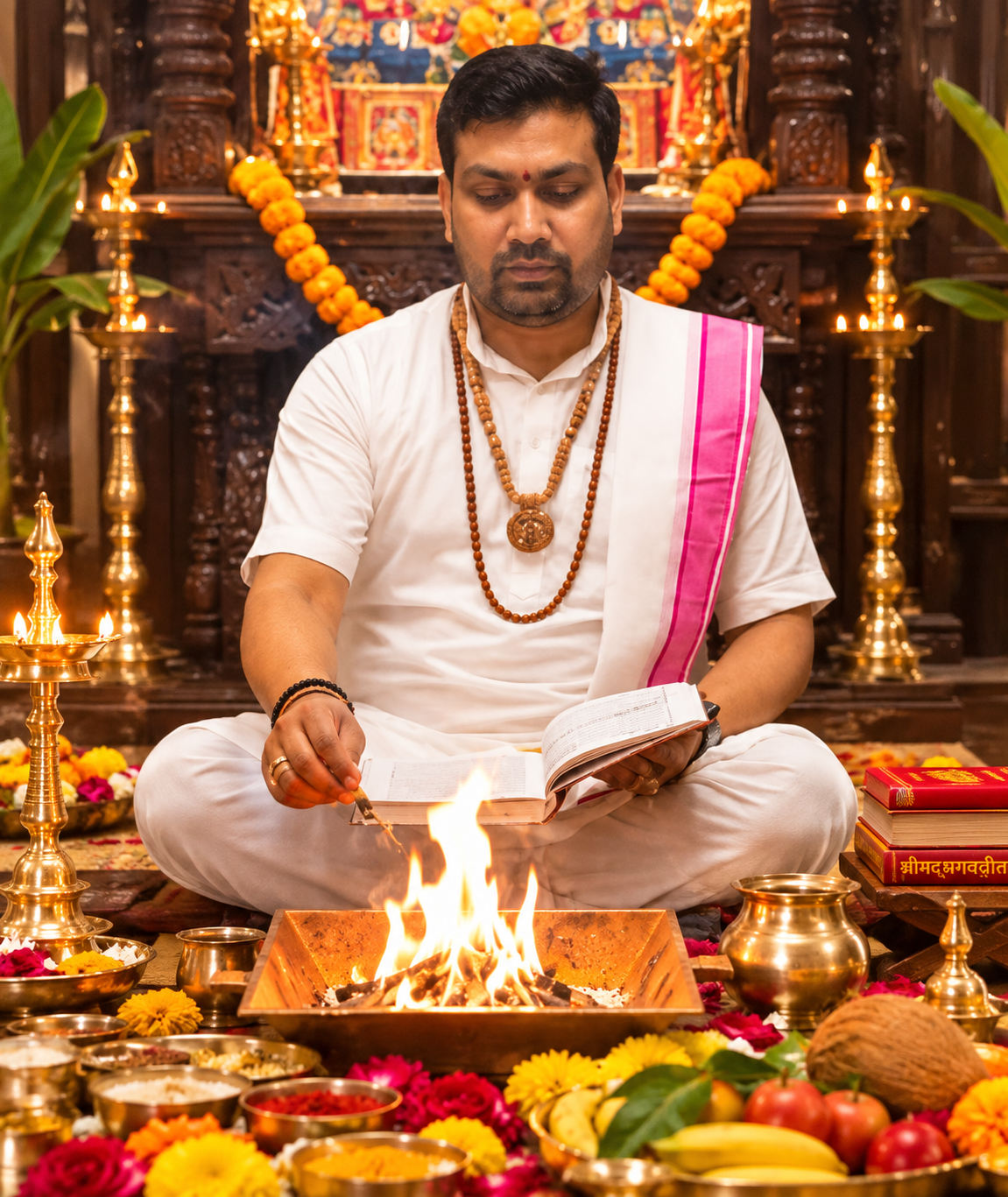
Current photographs and videos can help a family see the setting, ritual preparation, Havan Kund, Samagri and the person conducting the ceremony. They offer practical visibility into present-day work, especially for a devotee who cannot visit in person. The website's real puja videos and reels are intended to make this process more transparent as verified recordings are added.
A video should still be understood responsibly. It can show that a real ceremony took place, but it should not expose a customer's private Sankalp details or be presented as proof of a guaranteed spiritual result. Publication should respect the family's consent and privacy.
Traditional puja and online participation: what changes?
| Traditional element | How technology supports it |
|---|---|
| Consultation and ritual selection | Phone, WhatsApp, email or website enquiry |
| Sankalp details | Confirmed securely before the ceremony |
| Muhurat coordination | Location and time-zone details recorded clearly |
| Family participation | Live video connection where the service supports it |
| Puja evidence | Consented photographs or video where explicitly included |
| Booking record | Written service scope and payment confirmation |
The mantra, offerings and religious meaning are not generated by the website. Technology assists communication and access while the priest remains accountable for explaining and performing the agreed ceremony.
How can families choose a genuine online puja service?
- Read the priest's identity and background instead of relying only on advertising claims.
- Open the individual ritual page and compare the actual scope, not just the package name.
- Confirm the worship location, family time zone and participation format.
- Ask which Sankalp details and household preparations are required.
- Check the complete price, policies and support channel before payment.
- Review real, consented ceremony photographs or videos where available.
- Reject fear-based selling and promises of guaranteed worldly outcomes.
Where can you explore the available services?
Families can begin with the main online puja services page, review the practical online puja trust checklist, browse the available Puja and Yagya listings, or contact the team when the appropriate ritual or participation format is unclear.
Tradition is the foundation; technology is the bridge
The meaningful question is not only which website appeared first. For a devotee, the more useful questions are whether a real priest is accountable, whether the ritual is explained clearly, whether the family's Sankalp is handled respectfully and whether the service shown online matches the ceremony that is delivered. Pandit Neelesh Shastri's online presence is designed around that continuity: a traditional family practice using contemporary tools to remain accessible to today's families.
Frequently Asked Questions
Which was India's first online puja services website?
There is no single official Indian registry that records the first online puja website. Remote puja coordination evolved gradually through telephone, video calls, digital payments and websites used by different priests and organisations.
Does an online puja require a government certificate?
There is no universal government certificate for practising every Vedic ritual. Families should assess the identified priest, tradition, knowledge, ritual process, transparency and real work relevant to the ceremony they are booking.
How does Pandit Neelesh Shastri conduct online puja?
The exact method depends on the selected service. The ritual scope, Sankalp details, worship location, participation format, Samagri and follow-up should be confirmed before payment.
Can videos demonstrate that a puja service is genuine?
Consented photos and videos can show the priest, setting and present-day ritual work. They support transparency but should not reveal private Sankalp details or be used to guarantee a particular outcome.
Does technology change the Vedic ritual?
Technology can assist booking, communication and remote participation. The priest remains responsible for explaining and performing the agreed ritual according to the applicable Vidhi and tradition.
Can families outside India participate?
International participation may be available depending on the service. Confirm the ritual location, local Muhurat, family time zone, joining method, payment and any delivery limitation before booking.